ORACLE · BRANCH KIOSK · UX CASE STUDY

Preparing service before
the customer reaches the counter.

A connected self-service and teller workflow that lets customers verify identity, select an account, upload documents and hand off a structured request for faster review.

RolePrincipal UX Designer
ScopeKiosk · Oracle Assistant · Mobile upload · Teller servicing
CollaborationProduct · Engineering · Banking SMEs · Redwood
Explore the case study
01 · Product Summary

A connected branch service handoff

The concept moves request preparation out of the teller conversation and into a guided kiosk journey. Customers authenticate, choose an account and service, upload supporting documents from their phone and receive a token linked to the request.

When the token reaches the teller, the correct workflow opens with the customer, account, request and uploaded data already in context. The teller reviews and approves rather than reconstructing the request from scratch.

My focus

Design the handoff, not only the kiosk

I shaped the end-to-end experience across identity, conversational guidance, cross-device upload, token generation and teller verification, including fallback and exception considerations.

Project details

Role
Principal UX Designer

Platform
Branch kiosk, mobile web and employee desktop

Primary use cases
Cash deposits, deposit creation, cheque book requests, address updates, nominee maintenance, joint-holder updates and other branch transactions and service requests handled by tellers and Single Window Operators

Prototype walkthrough
Address update illustrates the shared kiosk-to-teller journey. Required fields, documents and review steps vary by service.

Principal-level contribution

I reframed a kiosk prototype as a service-orchestration problem spanning customer and employee channels. The key design decision was to carry verified intent and request data forward, while keeping the teller accountable for regulated review and final approval.

Case-study boundary: This is prototype work. The workflow benefits and success measures below are design hypotheses for validation; no production handling-time reduction is claimed.
02 · Problem Statement

The counter became the first place a request was understood

Customers arrived with a service need, but identity checks, account selection, explanation, form completion and document handoff began only after the token was called. The teller had no useful context before the conversation started.

Pain point 01

No request context

The teller first has to discover what the customer wants before opening the right workflow.

Pain point 02

Repeated information

Account and request details are read from paper or repeated verbally, then keyed into the system.

Pain point 03

Document friction

Physical and digital documents still need to be handed over, interpreted and linked to the request.

Pain point 04

Queue pressure

Discovery and data entry happen at the counter while the visible queue continues to grow.

03 · Research Framing

Designing for the range of branch services

The research framing considers everyday work across cash deposits, cheque book requests, deposit creation, address changes, nominee maintenance and joint-holder updates. Each service needs different inputs and checks, but all benefit from a clear handoff of customer identity, account, intent and prepared data.

Lens 01

Task decomposition

Mapped common preparation steps across services: identity and account selection, service-specific inputs, required evidence and confirmation. Cash counting and final verification remain with the teller.

Lens 02

Service handoff

Defined a shared request package: customer, account, service type, token, entered data and evidence where required. Deposit amounts, cheque book preferences and maintenance details vary by request.

Lens 03

Risk and recovery

Considered failed verification, incorrect account choice, cash amount discrepancies, missing signatory or nominee details, interrupted uploads and requests requiring further approval.

Personas & User Goals

Two perspectives on prepared branch service

The customer prepares the request; the teller verifies and completes it. These personas and goals cover cash deposits, deposit creation, cheque books and account maintenance. Select any template to view it full-size.

Personas

Persona 01

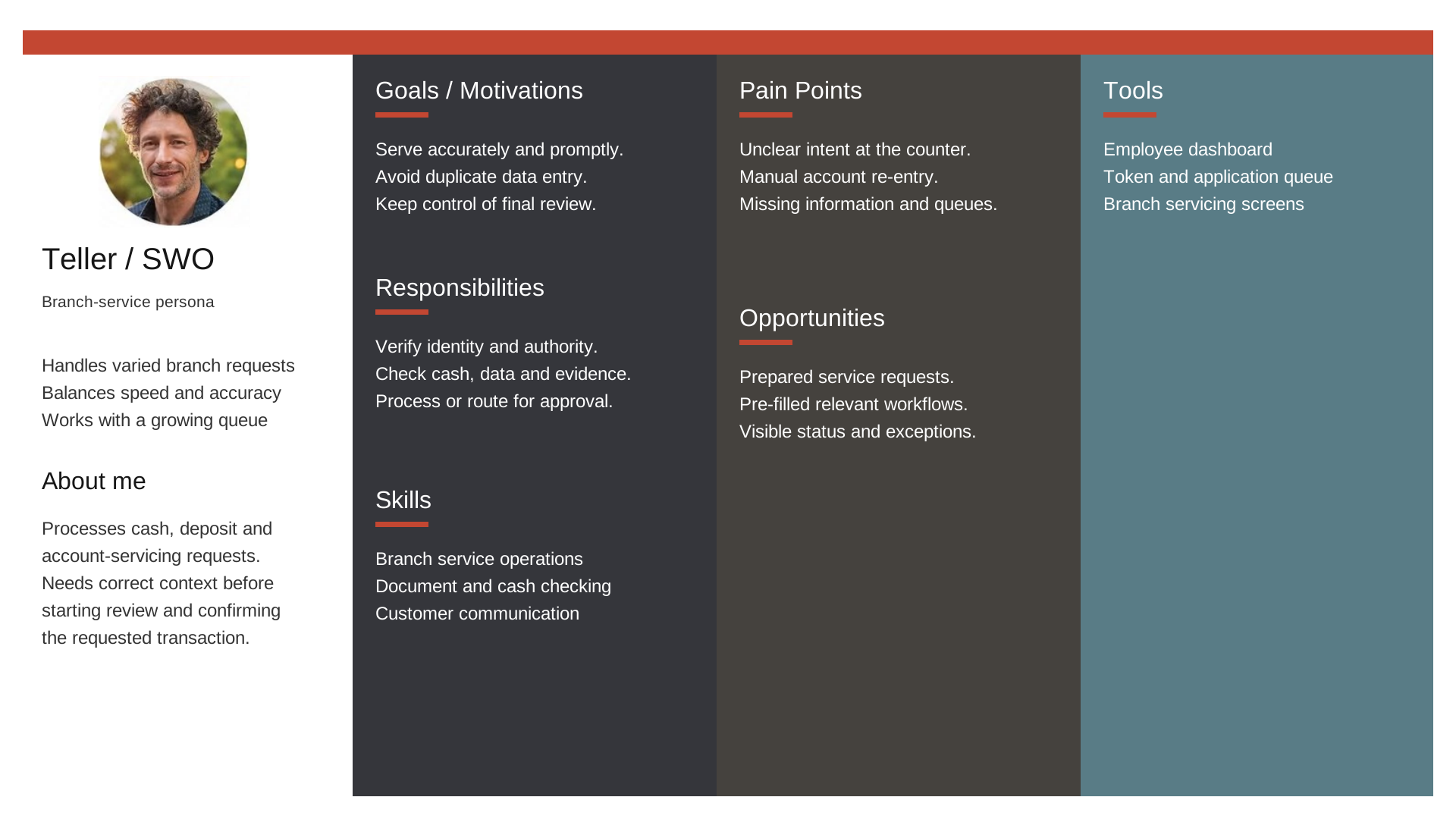
Teller / Single Window Operator

Responsibilities: verify identity, interpret requests, process transactions and manage queue flow.

Pain points: manually reads or asks for account details, discovers the request at the counter and re-keys information while the queue grows.

Goal: Process requests quickly and accurately without spending the opening minutes reconstructing information that could already be available.
Persona 02

Customer / Branch visitor

Responsibilities: take a token, prepare documents, explain the request and confirm the final outcome.

Pain points: cannot prepare the request in advance and may repeat the same details through paper, conversation and teller entry.

Goal: Get served with less waiting and repetition, while remaining in control of identity, account and document choices.

User Goals

Teller / Single Window Operator

User goal
I need a prepared request with the correct customer, account and service details, so that I can verify and complete branch work accurately without re-entering information.

Sub-goals

  • Open the token-linked request and confirm the selected account.
  • Review the service-specific fields and supporting documents.
  • Check physical cash, customer authority and required approvals.
  • Resolve missing information, process the request and explain the outcome.

Customer / Branch visitor

User goal
I need to prepare my branch request before reaching the counter, so that I can receive the right service without repeating my information.

Sub-goals

  • Choose a supported verification method and the correct account.
  • Select the service and enter the relevant details.
  • Upload documents when required and confirm the request package.
  • Keep the token, complete any teller checks and confirm the outcome.
Service-specific data carried into teller review
Branch serviceCustomer preparesTeller verifies
Cash depositAccount, amount and denomination breakdownPhysical cash against declared values and required checks
Cheque book requestAccount, book preferences and collection or delivery choiceEligibility, charges and delivery details
Deposit creationFunding account, amount, term and maturity instructionsProduct terms, funding, eligibility and customer confirmation
Address / nominee / joint holderRequested changes and relevant documentsEvidence, consent, authority and any additional approval

Shape of data & success criteria

For a pilot, I would instrument the handoff rather than inventing impact figures. These measures test whether the concept reduces work without hiding failure or shifting effort to the customer.

TimeLogin-to-token and token-to-submit
Re-entryFields repeated or corrected by the teller
HandoffRequests opening with correct context
RecoveryCompletion after scan or upload failure
04 · Experience Strategy

From counter-first service to prepared service

As-is script

The request starts after the wait

  1. Customer: takes a token and waits without preparing the request in the system.
  2. At the counter: explains the need and presents paper or digital documents.
  3. Teller: identifies the customer, account and correct workflow.
  4. Processing: re-enters details, checks documents and resolves missing information.
Future-state script

The request is ready before the counter

  1. Customer: verifies identity, selects an account and describes the service at the kiosk.
  2. Phone handoff: scans a QR code and uploads supporting documents privately.
  3. Token: is generated only after the customer confirms the request package.
  4. Teller: opens a pre-filled workflow, verifies the evidence and approves or requests more data.
Signature moment · Context arrives with the customer

“Your request is ready. Let’s verify it together.”

The teller opens the token and sees the selected account, service and prepared details. For cash deposits, the next step is checking the cash; for servicing, it is checking the data and evidence. The customer continues the request without repeating the whole story.

Prepared request → Teller verification → Completion
01VerifyCustomer identity
02PrepareAccount + request
03UploadDocuments on mobile
04GenerateLinked service token
05ReviewTeller verifies + acts
05 · Customer Flow

Make identity flexible, then make intent explicit

01Choose a verification method

Multiple entry paths avoid turning one authentication method into a dead end.

02Confirm recognition

The prototype uses face scan to establish customer context before service selection.

03Select the account

The assistant exposes the available banking relationships before proceeding.

04Choose or describe the service

Frequent actions and a conversational prompt support both recognition and free-form intent.

06 · Cross-device Handoff

Use the kiosk for guidance and the phone for private document access when needed

In this prototype walkthrough, the customer enters “Address update.” Oracle Assistant turns that intent into a structured request and displays a QR code. Scanning it opens a temporary mobile upload flow, avoiding email, cables or browsing personal files on a shared kiosk.

05State the request

Natural-language intent is translated into the address-update service.

06Scan the QR code

The customer moves only document selection to their own device.

07Upload on mobile

Selected files are visible before returning to the kiosk.

08Review returned files

The kiosk confirms which documents were linked to the request.

09Confirm the package

Explicit confirmation prevents accidental submission.

10Generate the linked token

The token carries the prepared request into the teller queue.

07 · Teller Handoff

Shift the teller from data entry to informed review

The employee dashboard exposes pending applications. Each row connects token number, account, customer, request type and status. Selecting edit opens the relevant servicing screen with available data already populated.

One workspace for queue awarenessThe teller can see service demand, pending documentation and assigned activity before opening a request.
11Find the prepared request

Token, account and request context appear together in the queue.

12Review the pre-filled workflow

The teller validates the address and evidence, requests missing data when needed, then submits.

08 · Validation Plan

Test the handoff under realistic branch conditions

The prototype should be evaluated as a connected service rather than as isolated screens. A successful kiosk flow is not enough if the teller receives incomplete context or the customer cannot recover from an interruption.

Scenario 01

Face scan fails

Can the customer understand the failure, choose another method and continue without losing progress?

Scenario 02

Wrong account selected

Can the account be changed before submission, and is the request always linked to the final choice?

Scenario 03

Upload interrupted

Can the customer safely retry, see upload status and avoid duplicate or partially linked documents?

Scenario 04

Teller needs more data

Can the employee correct or pause the request while preserving an auditable link to customer-provided information?

Recommended participants: walk-in customers with varied digital confidence, tellers who handle profile maintenance, and branch operations staff responsible for queues and exceptions.
09 · Result

A reusable pattern for prepared branch service

Across branch transactions and servicing, the concept establishes a clear division of work: customers prepare and confirm their request, the system preserves verified context, and tellers review and approve. This reduces avoidable discovery and re-entry without removing the judgement required at the counter.

For customers

Less repetition, clearer progress and a private way to upload documents from their own phone.

For tellers

Request intent, account and documents arrive together, shifting attention from setup to verification.

For the platform

A repeatable service pattern for cash deposits, cheque books, deposit creation, nominee and joint-holder maintenance, address changes and other branch requests.

Design outcome

One request package, carried across three touchpoints

Kiosk guidance, mobile document access and teller review now behave as parts of one service. The most important outcome is continuity: customers do not have to start again when they move from self-service to the employee counter.

© Designed & Coded by Mahendra Bhagavath