ORACLE · AI-ASSISTED BANKING · UX CASE STUDY

Designing AI assistance for
smarter branch decisions.

Connecting customer insight, circular guidance, branch priorities and conversation history to help employees serve customers with confidence.

RolePrincipal UX Designer
ScopeBranch servicing · Customer 360 · Teller · IRA
CollaborationProduct · Engineering · Banking SMEs · Redwood
Explore the case study
01 · Product Summary

Oracle Branch Banking – AI

The concept brings identity verification, customer intelligence, sentiment preparation, financial forecasting, product recommendations and contextual actions into one connected experience. AI supports the employee's judgement; the banker remains responsible for verification, suitability and the final customer conversation.

My focus

AI use-case implementation across multiple screens: customer relationship intelligence, circular guidance, branch insights, sentiment analysis and contextual servicing.

Project details

Role Principal UX Designer
Duration Ongoing
Collaboration Product, engineering, banking SMEs and Redwood
Scope Branch servicing, Customer 360, Deposits, Accounts, Teller and IRA

Case-study boundary: The screens represent concept and prototype work. Benefits are framed as design hypotheses and workflow value; production conversion or revenue impact is not claimed without post-launch evidence.
02 · Problem Statement

Employees needed context before they could act

Pain point 01

Fragmented customer context

Relationship Managers must visit multiple areas to understand the customer before recommending a relevant product.

Pain point 02

Circulars disconnected from the task

Employees need to find, read and interpret 100+ circular documents instead of seeing guidance relevant to the current screen.

Pain point 03

No consolidated branch overview

Branch activity, service issues and suggested actions are spread across different places, making prioritization difficult.

Pain point 04

Conversation history is hard to recall

Many customer visits make it difficult to remember the last conversation, unresolved concerns and whether the customer was satisfied.

03 · Research Foundation

Extending established branch research into AI-specific hypotheses

The AI concepts built on the wider branch-banking research program: persona studies, workflow walkthroughs, banking-SME collaboration and usability findings from more than 10 bank users. The AI layer introduced new questions about trust, explanation, consent, data quality and recovery.

Research inputs

4 rolesBranch personas and distinct responsibilities
10+ usersBroader branch-workflow usability research
SME reviewsBanking rules, exceptions and operational context
Workflow evidenceExisting screens, tasks and cross-product dependencies

What the AI concepts still needed to validate

Research questionWhy it mattersSuggested methodSuccess signal
Can employees understand why a recommendation appears?Unexplained suggestions reduce trust and may create unsuitable conversations.Think-aloud concept test with Relationship ManagersUser can explain the evidence and limitations in their own words.
Does the summary reduce preparation effort?A Customer 360 view is valuable only if it replaces manual information gathering.Benchmark current and proposed preparation tasksLower time and fewer screens without missed critical information.
Is a low face-match result handled safely?An uncertain match must not expose customer data or create a dead end.Test low-confidence and camera-failure scenariosUser selects an approved fallback without treating uncertainty as rejection.
Are product recommendations suitable and actionable?Relevance must include eligibility, affordability and customer benefit.Scenario review with banking, compliance and product SMEsCorrect recommendation, rationale, disclosure and next action.
Evidence separation: Existing branch research informs the problem and personas. AI trust, recommendation quality and conversion require dedicated validation and post-launch measurement.
04 · Personas & User Goals

Three perspectives on better branch service

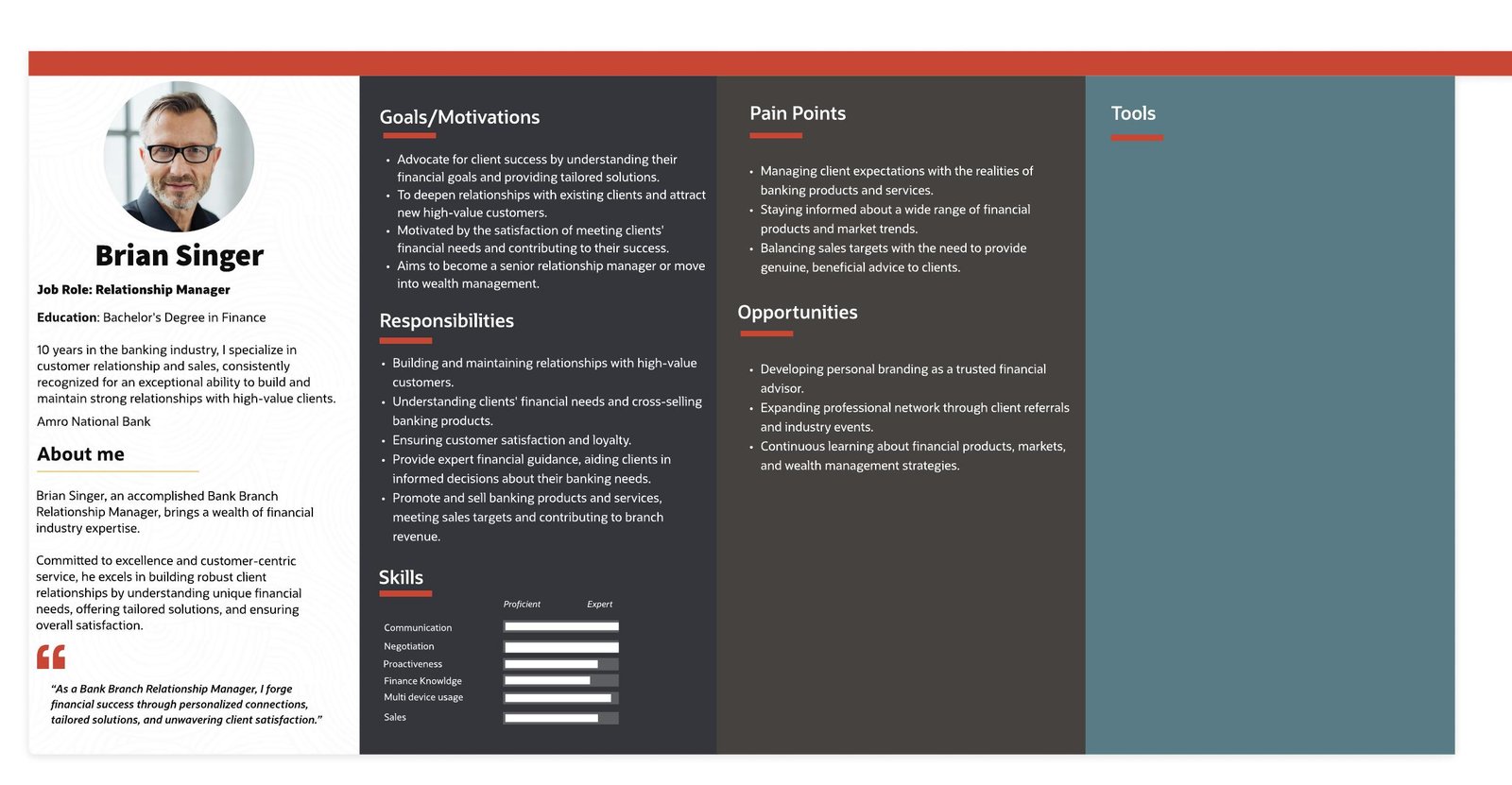
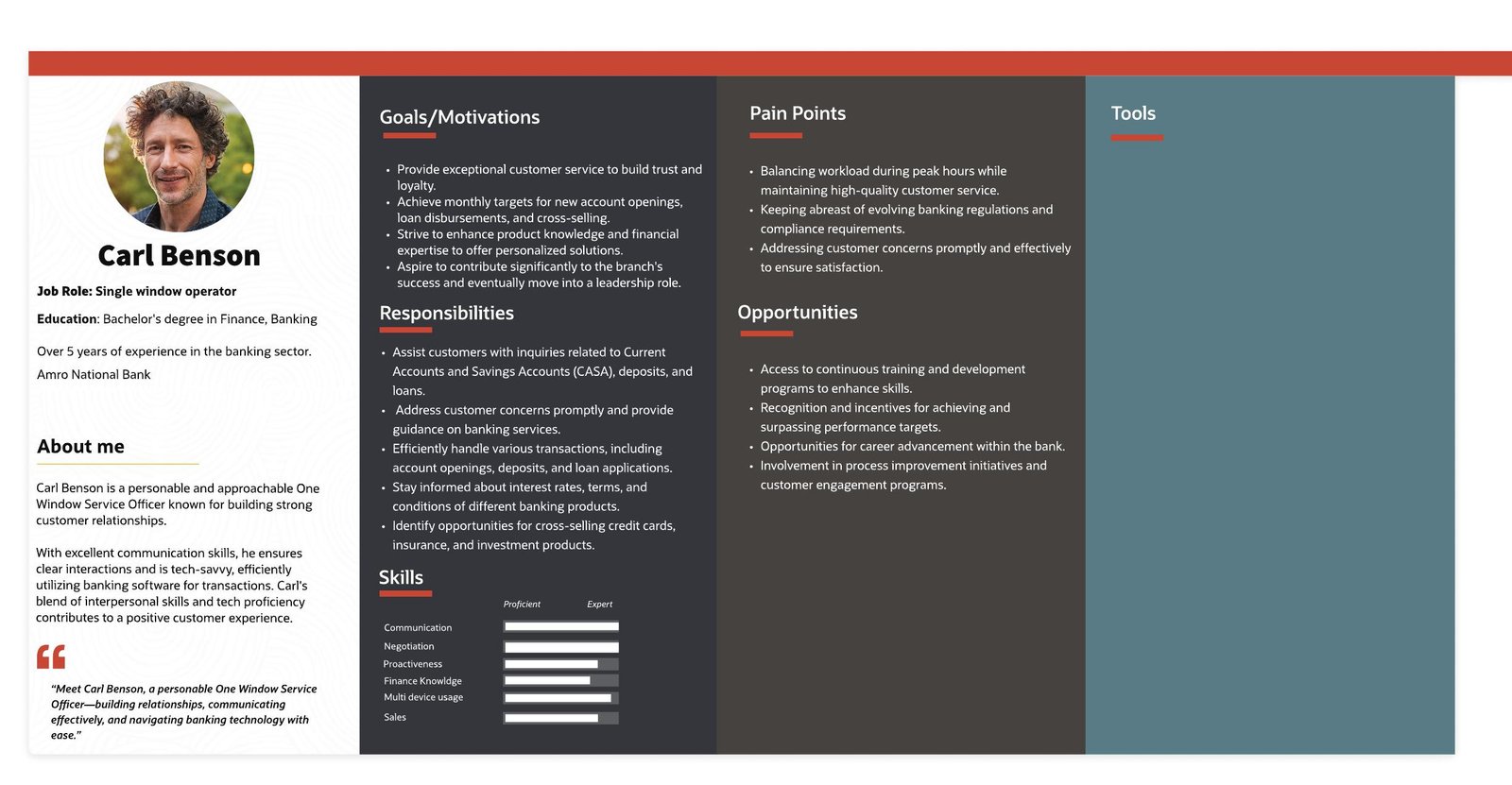
The Relationship Manager and Single Window Operator artifacts retain the supplied branch-research templates. The customer is an illustrative extension. Select any image to read the full-size artifact.

Personas

Relationship Manager persona template
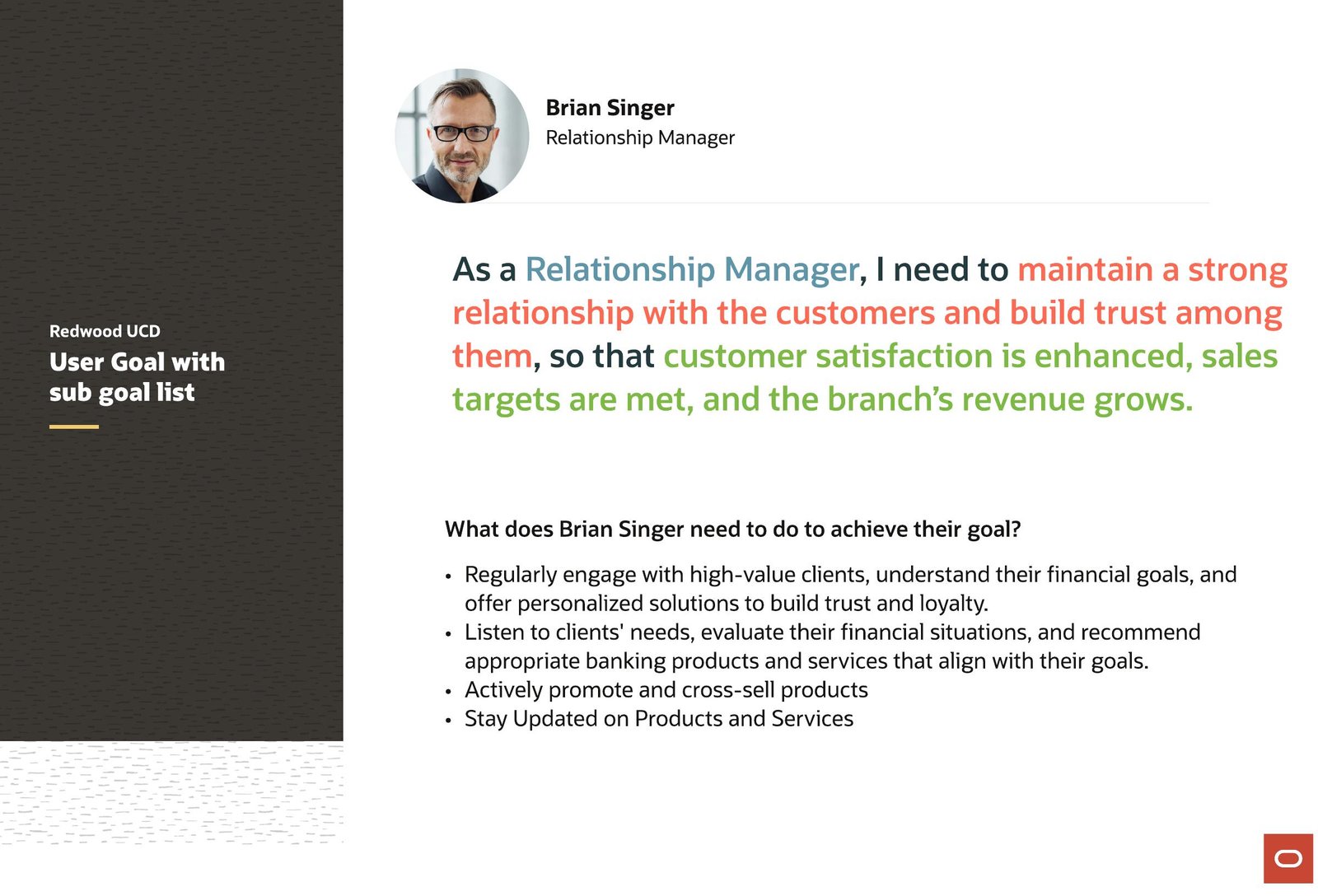
Relationship ManagerPrepare a relevant customer conversation from one trusted relationship view.
Single Window Operator persona template
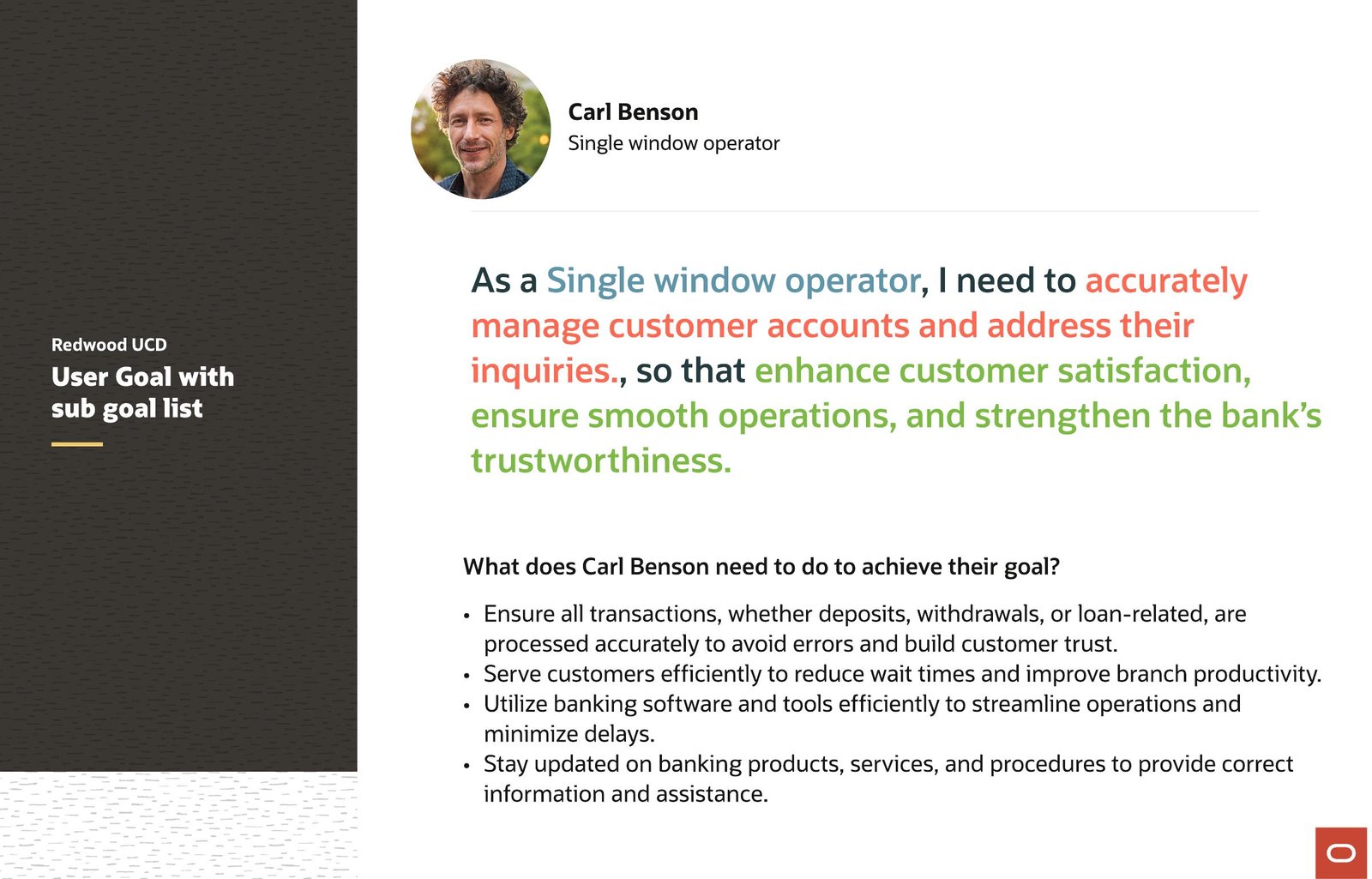
Single Window OperatorComplete service requests with current guidance and persistent customer context.
Customer persona template
CustomerReceive relevant service with clear explanations and meaningful choice.

User Goals

Relationship Manager goal template
Relationship ManagerPrepare a relevant customer conversation from one trusted relationship view.
Single Window Operator goal template
Single Window OperatorComplete service requests with current guidance and persistent customer context.
Customer goal template
CustomerReceive relevant service with clear explanations and meaningful choice.

Shape of Data & Success Criteria

Each use case has a different data shape: record types, volumes, history, exceptions and response-time needs. The criteria below connect those conditions to the task the employee must complete.

Evidence status: The 100+ circular-document scale comes from the supplied problem statement. Other volumes, baselines and numeric targets require measurement with banking teams. Success criteria below are proposed validation measures, not achieved results.

Use case 01

Customer identification & facial verification

Data involved
Customer identity reference, consent, captured image, match score, quality status and verification outcome.

Scale & variation
Measure verification attempts per day, retries per session, response time and fallback frequency. Include low-quality captures, uncertain matches and camera failure.

Success criteria
The employee completes verification or an approved fallback without exposing another customer’s information.

How to measure
Time to verified context; successful fallback rate; false-accept and false-reject rates against bank-approved thresholds.

View related solution →
Use case 02

Relationship Manager · Customer 360

Data involved
Customer portfolio, linked accounts, deposits, loans, balances, transactions, notifications and pending service needs.

Scale & variation
Measure customers per manager, products per customer and transaction history per relationship. Include no-product, multiple-product and missing-data cases.

Success criteria
The banker prepares from one consolidated view and can inspect the source details without missing critical information.

How to measure
Preparation time; screens visited; critical information missed; time to open supporting account details.

View related solution →
Use case 03

Cash-flow forecasting & deposit insights

Data involved
Dated income, expenses, recurring payments, upcoming obligations, deposit maturity dates, blocks and available funds.

Scale & variation
Measure history length, transaction volume, forecast horizon and maturities per customer. Include irregular income, sparse history and overdue items.

Success criteria
The banker identifies upcoming commitments and explains projected shortfalls or excess funds, including uncertainty.

How to measure
Task accuracy and decision time; forecast error against actual cash flow when available; missed maturity or payment alerts.

View related solution →
Use case 04

Circular guidance on transaction screens

Data involved
Approved circulars, document versions, effective dates, affected products, screen mappings and source passages.

Scale & variation
100+ documents were identified in the problem statement. Measure document length, updates per month and screens affected; include superseded and conflicting guidance.

Success criteria
The employee finds the current instruction for the active task, checks its source and applies it correctly.

How to measure
Time to correct guidance; source relevance; correct application rate; outdated or unsupported guidance rate.

View related solution →
Use case 05

Consolidated branch overview & suggested actions

Data involved
Branch activity, pending requests, queue status, exceptions, service concerns, action owners and priority indicators.

Scale & variation
Measure visitors, transactions, open exceptions and pending actions per branch per day. Include peak periods, stale data and competing priorities.

Success criteria
The manager identifies the highest-priority issue, understands why it matters and assigns or opens the appropriate action.

How to measure
Time to identify priority; priority accuracy in reviewed scenarios; action completion time; unresolved backlog.

View related solution →
Use case 06

Sentiment analysis & conversation preparation

Data involved
Permitted interaction history, timestamps, service concerns, source excerpts, sentiment signals, confidence and employee corrections.

Scale & variation
Measure interactions per customer, history length and unresolved concerns. Include first visits, missing history, mixed sentiment and incorrect summaries.

Success criteria
The banker recalls the last conversation and unresolved needs, checks the evidence and can correct or disregard the summary.

How to measure
Preparation time; summary factual accuracy; unresolved concerns recalled; correction success; inappropriate reliance on sentiment.

View related solution →
Use case 07

AI product recommendations · Accounts, Deposits & IRA

Data involved
Customer needs, contribution amount, eligibility, available products, rates, tenure, charges, limits and recommendation reasons.

Scale & variation
Measure candidate and eligible products per request, applicable criteria and missing fields. Include no eligible product, tied options and incomplete customer data.

Success criteria
The banker explains product fit and trade-offs, compares alternatives and chooses to discuss or dismiss a suggestion.

How to measure
Explanation comprehension; suitability exceptions; accepted, dismissed and corrected suggestions; qualified application completion after launch.

View related solution →
Use case 08

Ask Oracle & contextual servicing actions

Data involved
Current customer and account context, employee intent, conversation turns, permissions, required fields and transaction status.

Scale & variation
Supplied examples cover joint holder, beneficiary, account transfer and cash deposit actions, plus product Q&A. Measure turns, handoffs and context switches per task.

Success criteria
The assistant opens the correct action with verified context preserved; the employee reviews and confirms before committing a transaction.

How to measure
Task completion time; navigation steps; repeated data entry; correct action routing; wrong-customer handoffs and recovery success.

View related solution →

As-Is Script

01

Customer arrives

Ask the customer to repeat their request and previous concerns.

02

Gather context

Visit account, deposit, transaction and interaction records separately.

03

Interpret guidance

Search circular documents and decide which instructions apply.

04

Choose an action

Reconstruct the situation from memory before servicing or recommending.

05 · Key Design Decisions

Connect insight to the next servicing action

Bring circular guidance into the screen

Decision: Show relevant guidance beside the affected transaction, with an effective date and a link to the source circular.

Why: Employees need the applicable instruction while serving the customer.

Concept direction; no circular-specific prototype was supplied in this folder.

Consolidate branch priorities

Decision: Bring branch activity, unresolved service concerns and suggested follow-up actions into one overview.

Why: Managers need to understand what requires attention before choosing an action.

The sentiment dashboard below illustrates part of this opportunity.

01

Identify

Verify the customer and protect relationship data with a bank-defined confidence threshold.

02

Understand

Bring accounts, deposits, loans, cards, transactions and financial health into one view.

03

Prioritize

Surface pending actions, financial shortfalls, sentiment and service risks.

04

Recommend

Match relevant products to customer needs, eligibility and financial circumstances.

05

Assist

Use Ask Oracle to answer contextual questions and reveal recommendation evidence.

06

Act

Deep-link into the appropriate servicing flow while preserving customer context.

06 · Concept 01 · Secure Identification

Confidence-based facial verification with a safe fallback

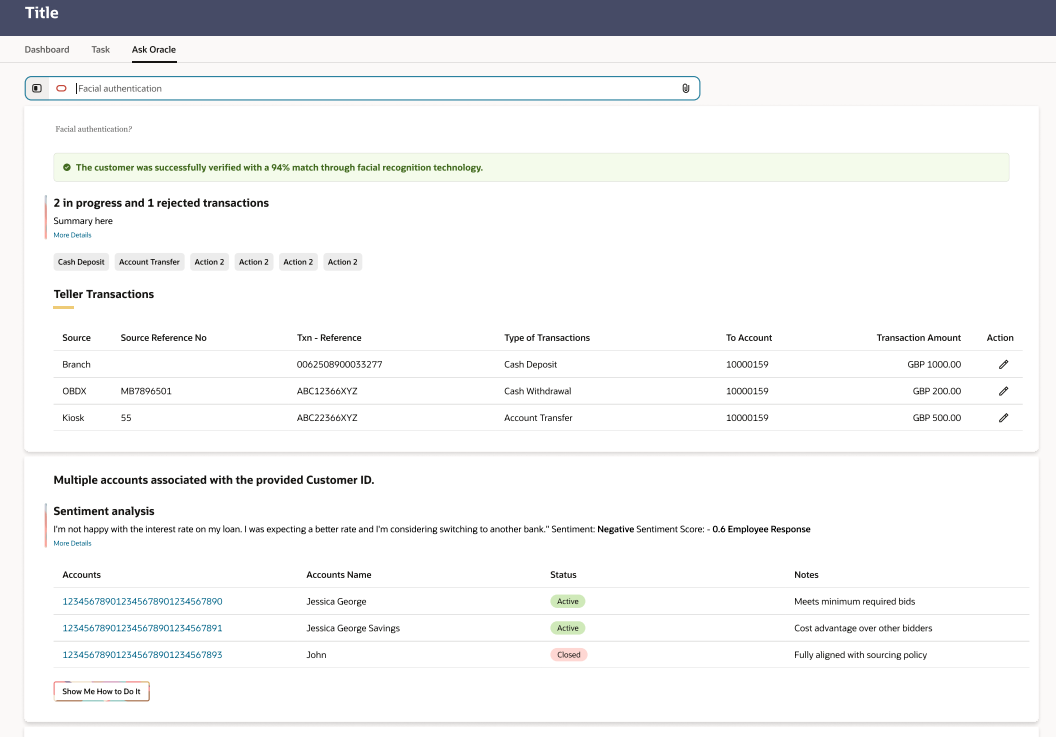
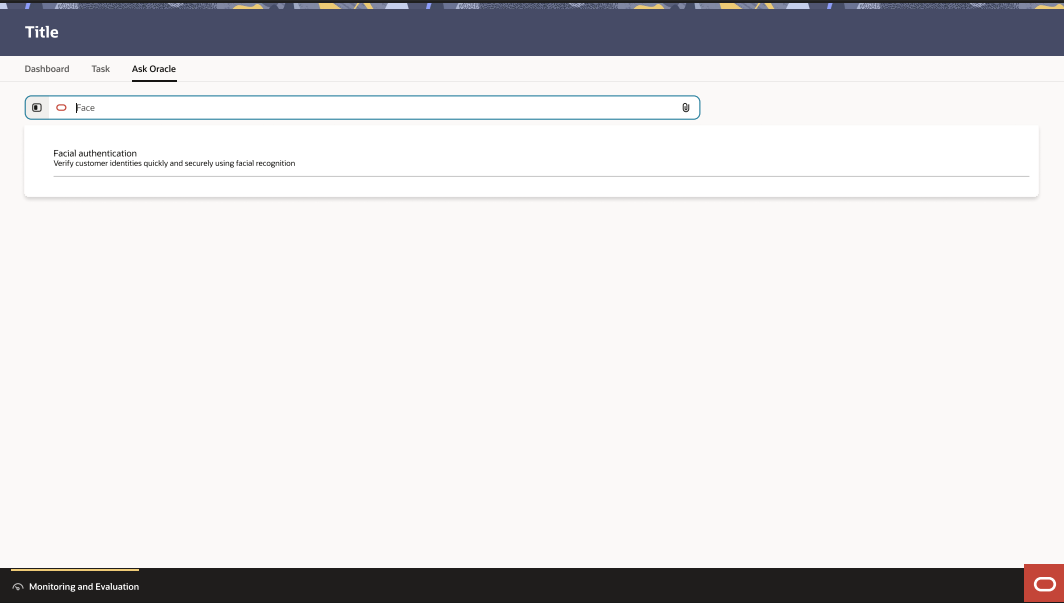
The employee launches facial authentication from Ask Oracle. The system captures the customer's face, performs the match and compares the similarity score with a bank-configured threshold. Customer information is revealed only after successful verification.

Step 01Launch

Start facial authentication from the existing employee workspace.

Step 02Capture

Guide the customer through consent, positioning, quality and liveness checks.

Step 03Compare

Calculate a face-match similarity score and compare it with bank policy.

Step 04Verify or recover

Open the customer context or continue with another approved method.

Ask Oracle facial authentication entry point
Entry point

Launch from Ask Oracle

Employees start verification without leaving their branch workspace.

Facial verification capture screen
Capture

Customer positioning and fallback

The verification screen keeps another approved method available.

Recognized customer confirmation
Match

Recognition confirmation

The matched customer is confirmed before servicing information is shown.

Verified customer context and transactions
Secure handoff

Verified customer context

The banker continues into pending transactions, accounts and relevant insights.

Critical decision

A low match is inconclusive, not a customer rejection

At or above threshold

Confirm verification, record the method and open only the information permitted for that employee role.

Below threshold or poor quality

Do not expose customer data. Offer OTP, document verification, security questions or a bank-approved manual process.

Terminology: A 94% result is a face-match similarity score, not a 94% probability that the person's identity is correct.
07 · Concept 02 · Relationship Intelligence

A Customer 360 workspace for the Relationship Manager

The relationship view combines customer health, accounts, credit, loans, notifications, cash-flow forecasts and upcoming obligations. The purpose is to reduce manual preparation and create a more informed conversation—not simply to maximize cross-selling.

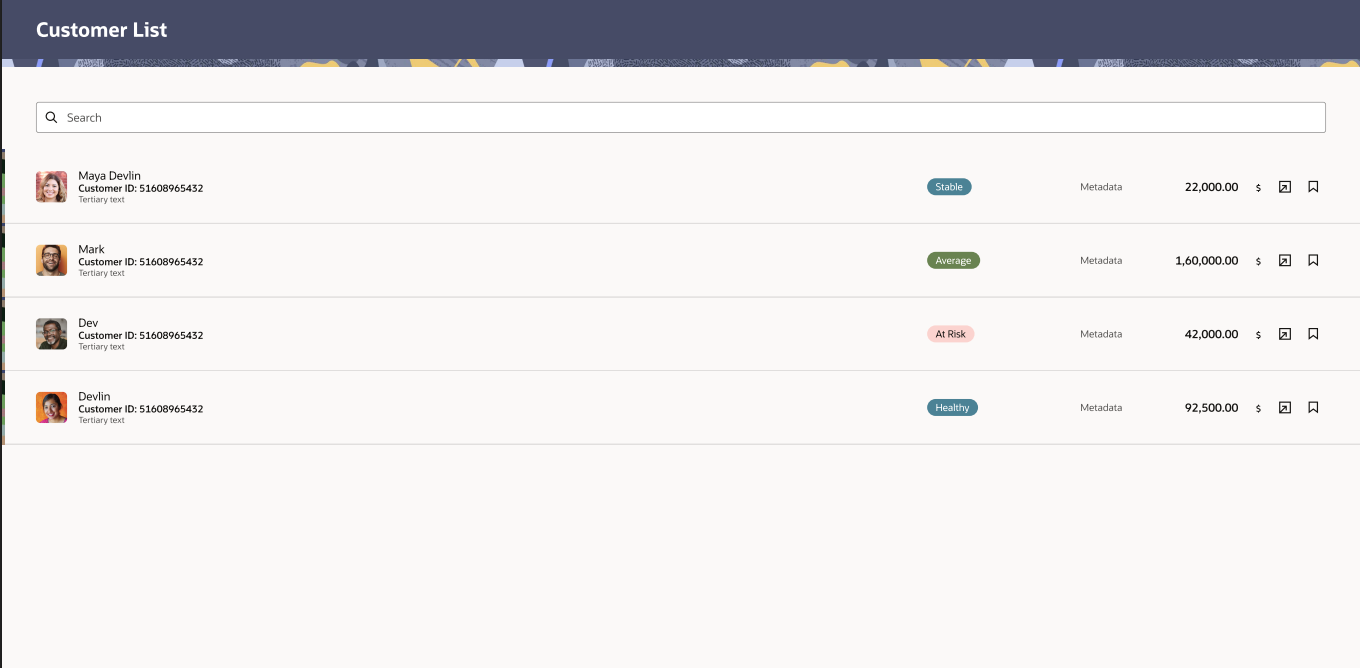
Relationship Manager customer list with financial health status
Portfolio view

Prioritize customer relationships

Status indicators help the Relationship Manager identify stable, healthy and at-risk relationships.

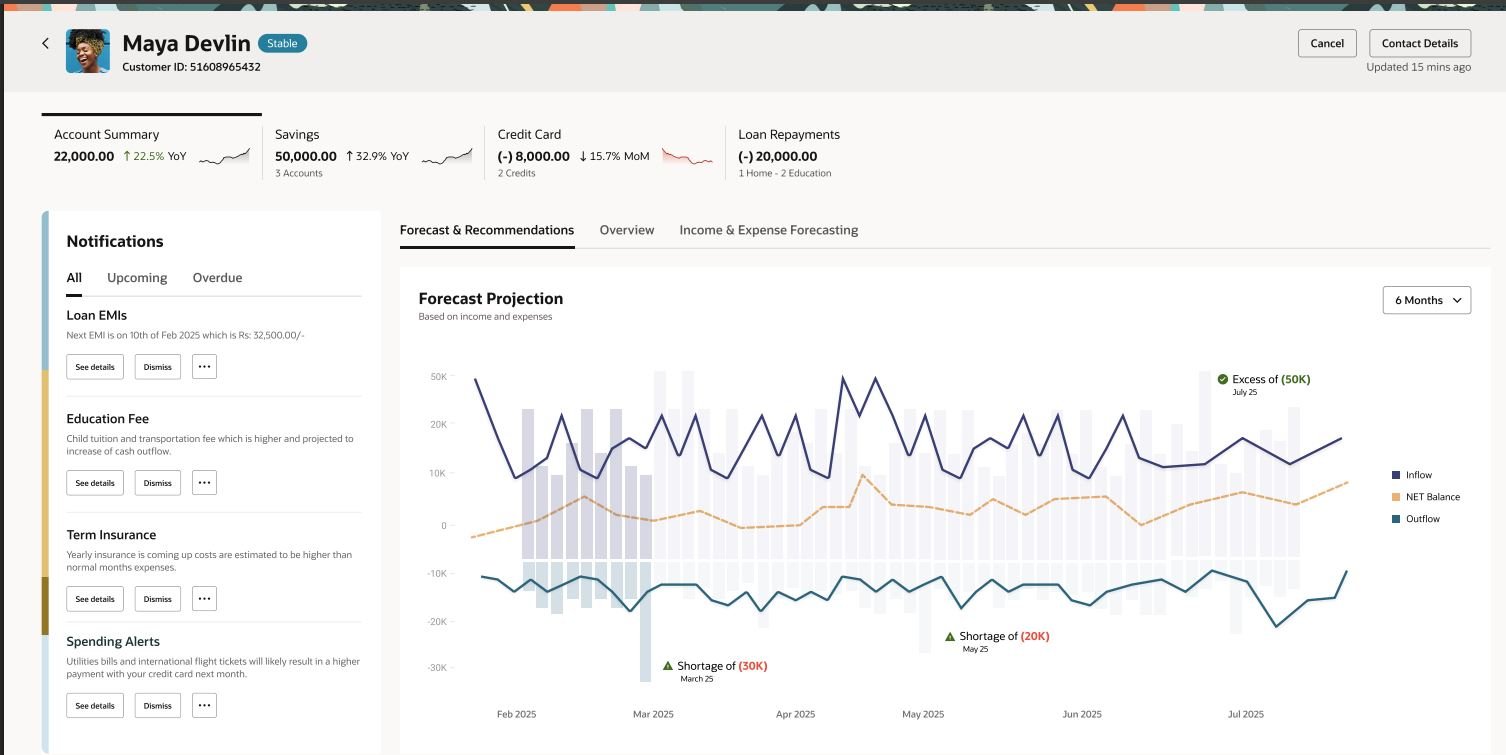
Customer forecast and AI recommendations dashboard
Forecast and recommendations

Prepare for the conversation

Projected inflow, outflow, shortages, excess funds and upcoming obligations are combined in one view.

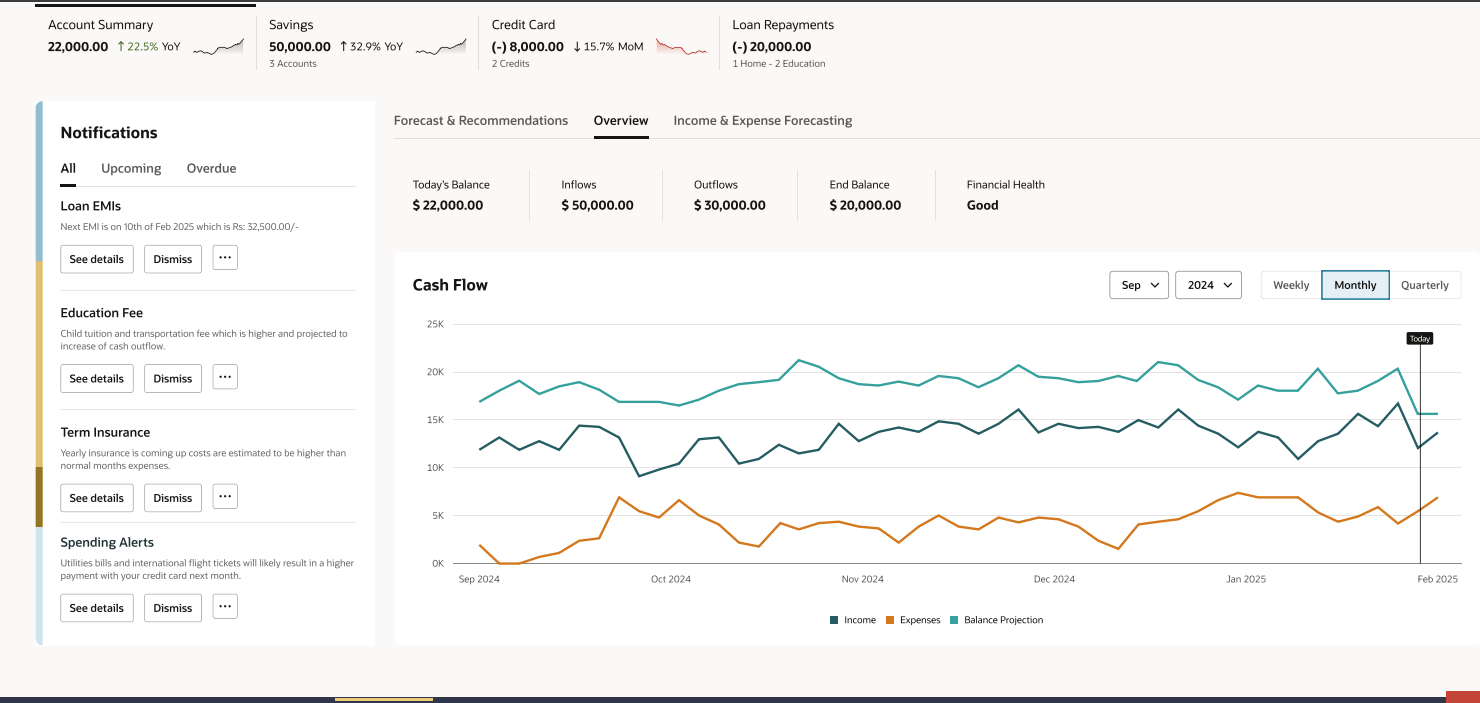
Customer cash flow overview
Overview

Understand financial health

A consolidated cash-flow view supports more informed discussions about customer needs.

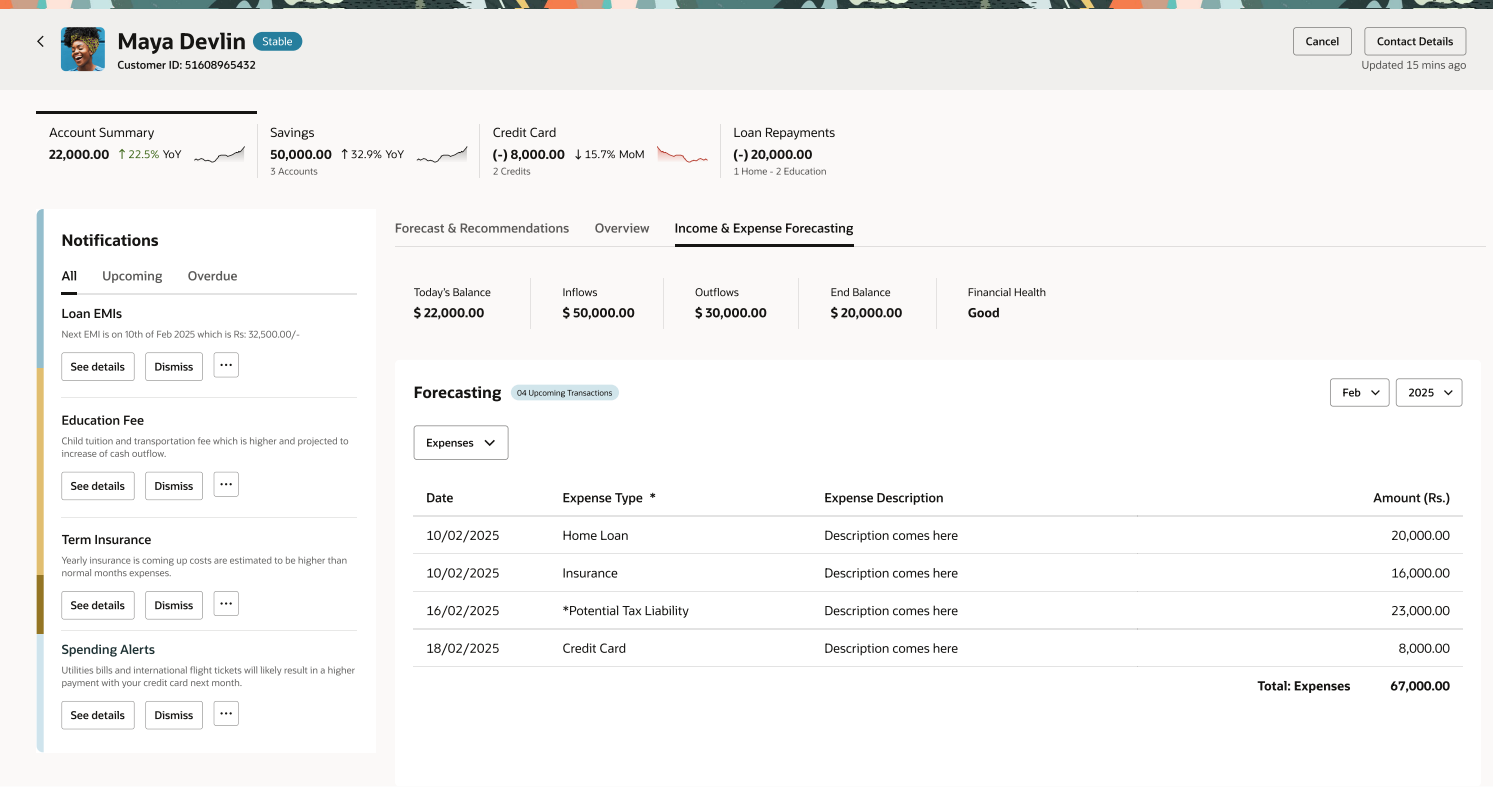
Income and expense forecast
Forecast detail

Anticipate upcoming commitments

Forecast transactions make potential shortfalls and payment pressure visible before a recommendation.

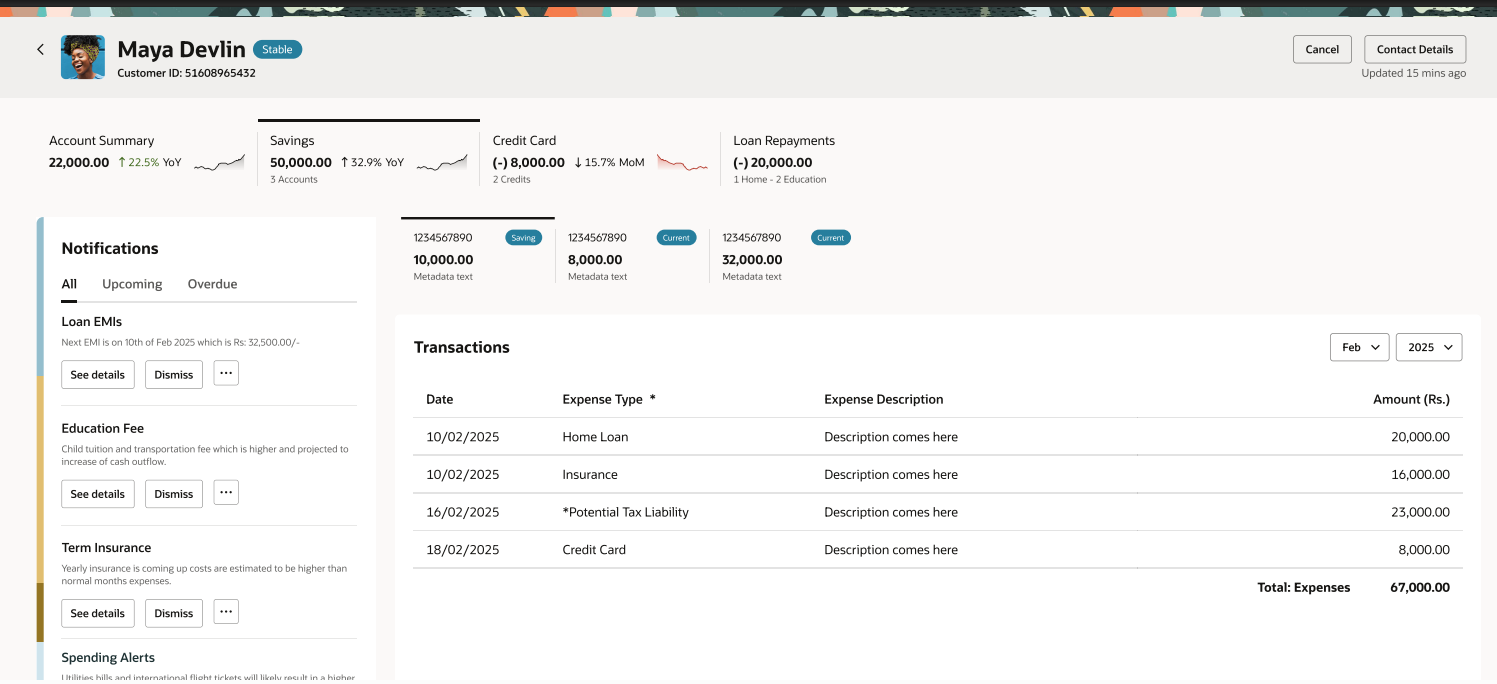
Customer account and transaction details
Supporting evidence

Move from summary to account detail

The Relationship Manager can inspect the accounts and transactions behind the high-level insight.

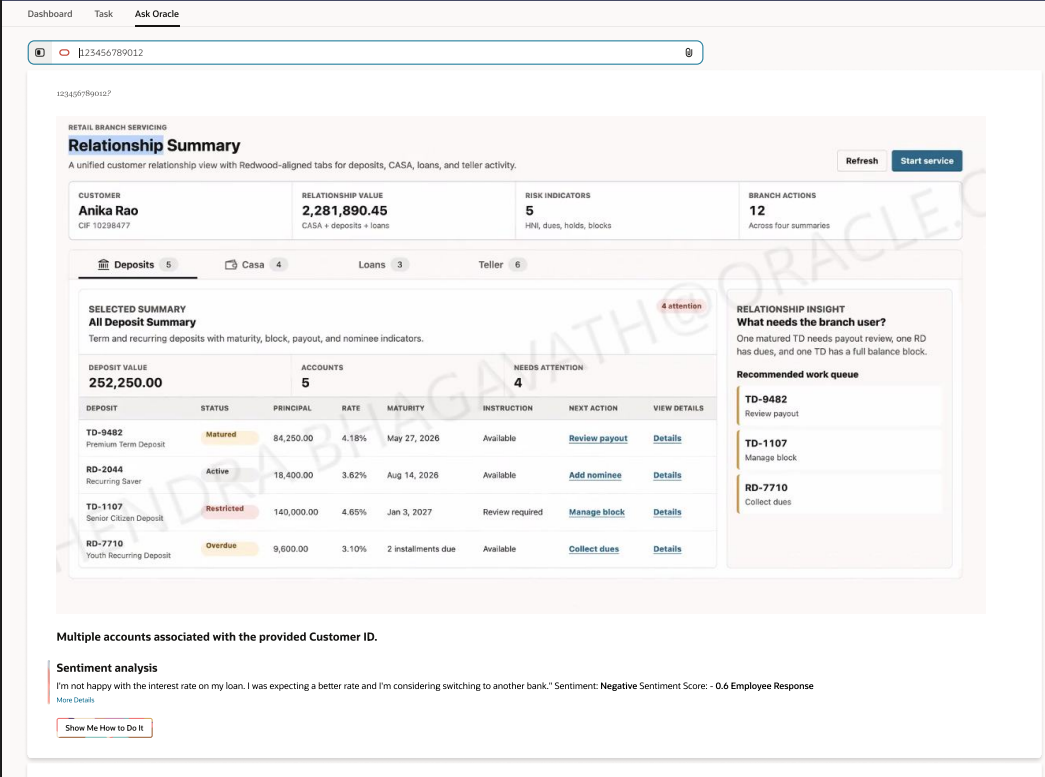
AI-assisted deposit relationship summary
Deposit relationship

Prioritized deposit servicing

Maturity, block, overdue and nominee indicators are converted into recommended branch actions.

Recommendation inputs

Existing productsBalances and cash flowUpcoming obligationsCustomer goalsEligibilityRisk and suitabilityInteraction history
Design principle: The system should recommend the most relevant and suitable next conversation, including “no offer” when financial stress, missing information or eligibility rules make a product inappropriate.
08 · Concept 03 · Conversation Preparation

Sentiment and interaction summaries help bankers prepare

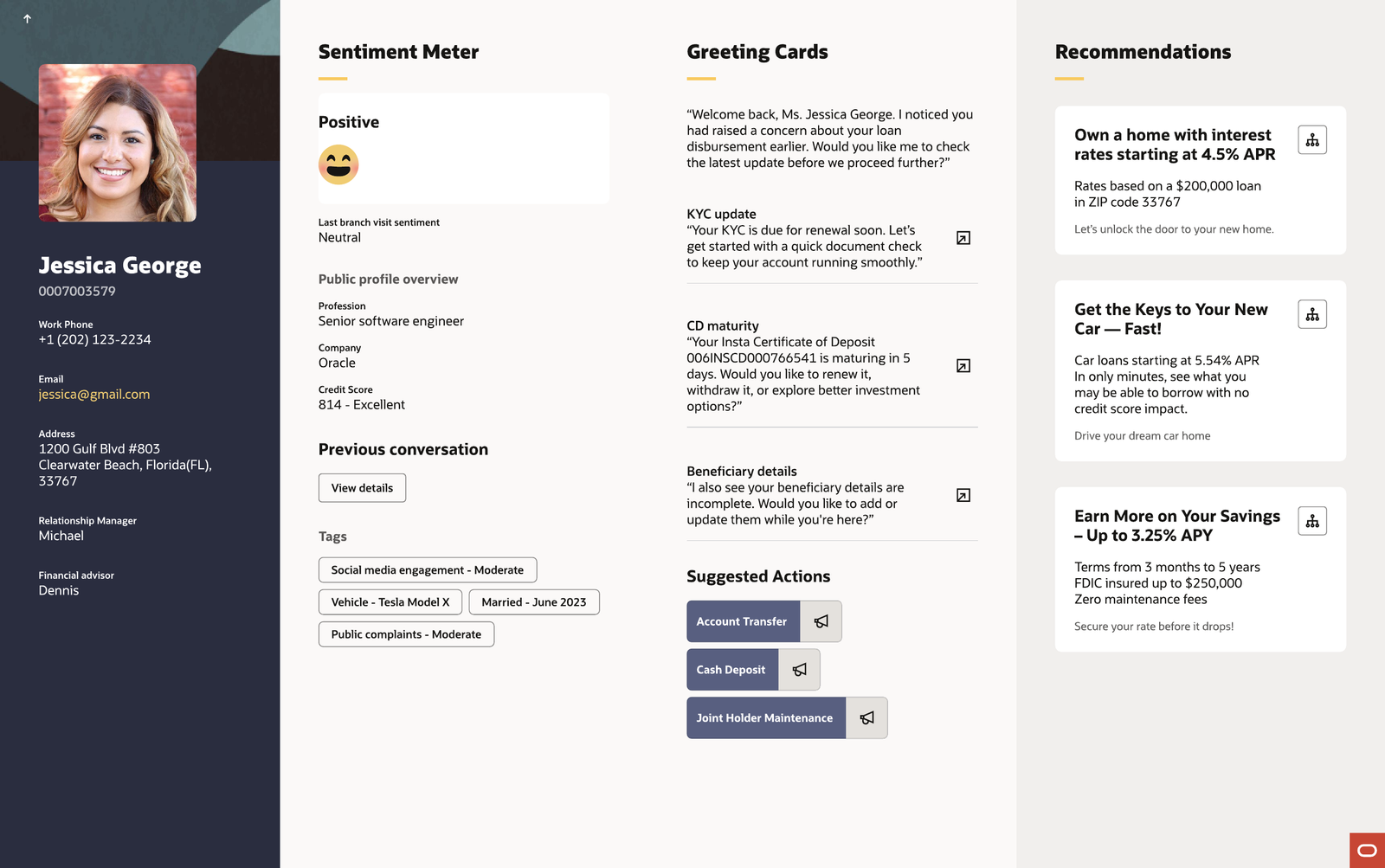
The concept summarizes the customer's latest permitted interactions—such as a consented call transcript, service history and governed public feedback—to help the banker understand tone, unresolved concerns and the most appropriate opening.

Customer sentiment, greeting guidance, actions and recommendations
AI preparation view

Sentiment, context and next actions

The employee sees the customer summary, previous conversation, service needs, suggested greeting and relevant actions before speaking.

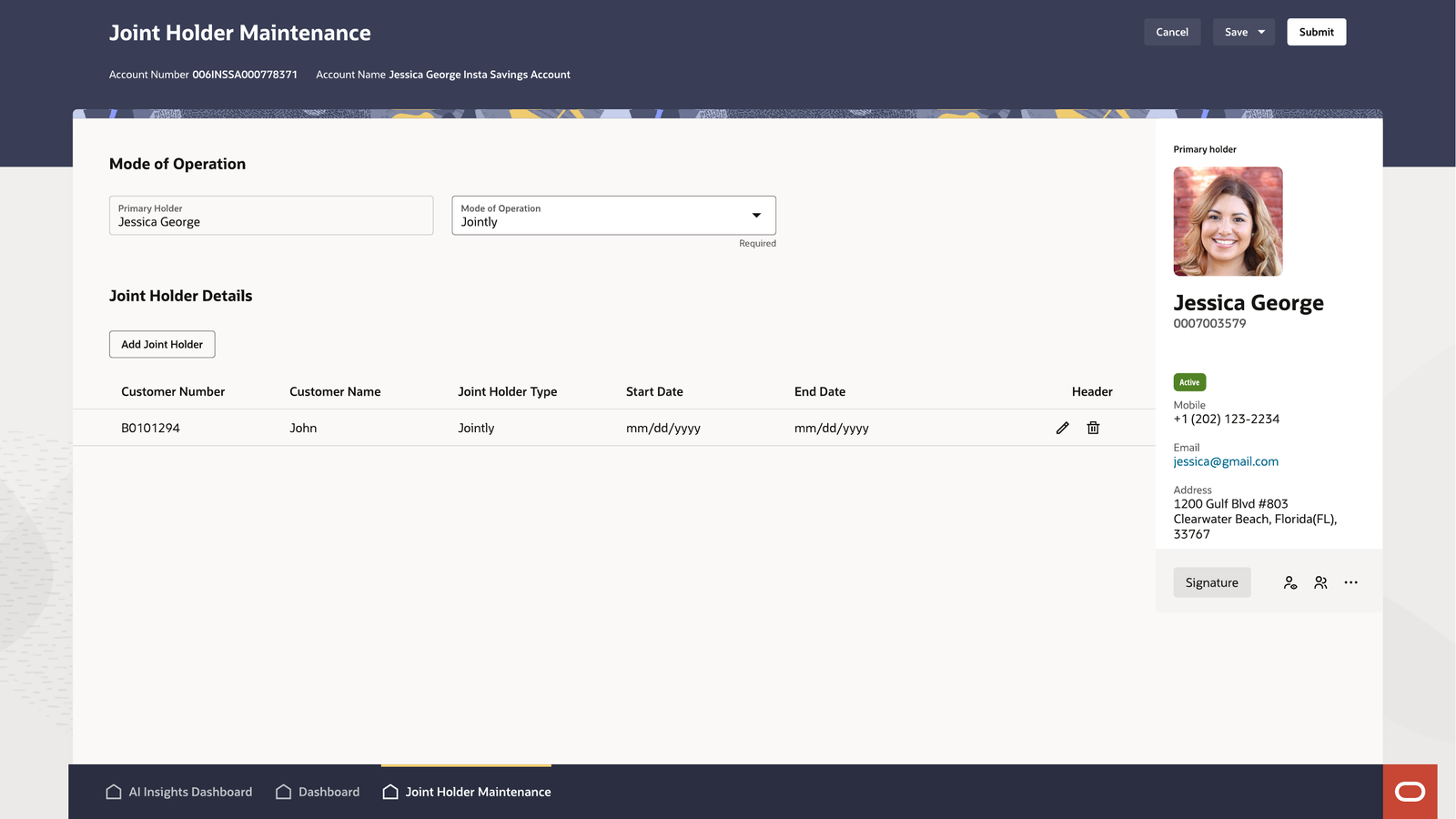
Joint holder maintenance action
Contextual action

Joint holder maintenance

The recommendation deep-links into the servicing workflow with context retained.

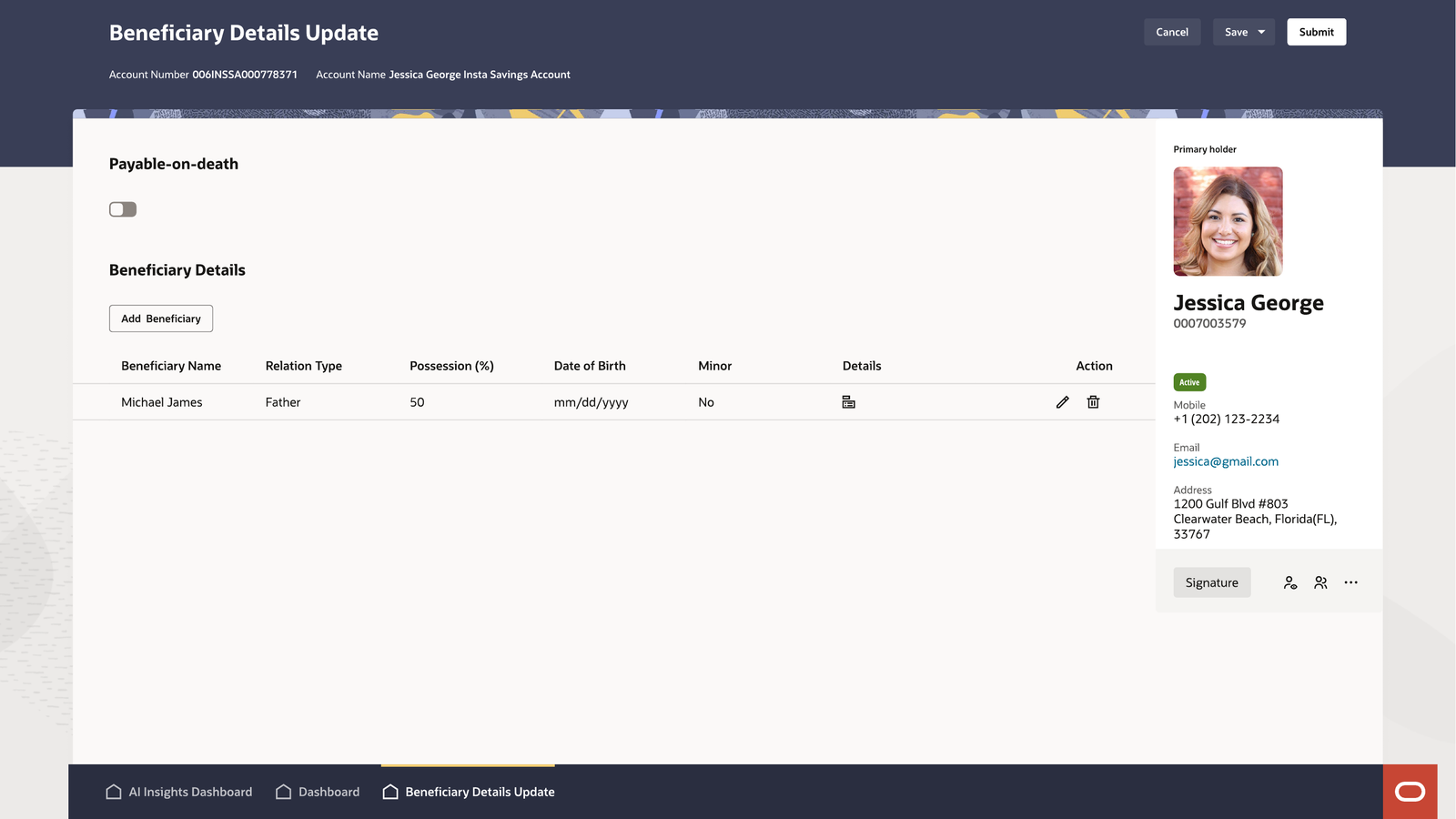
Beneficiary update action
Contextual action

Beneficiary update

Pending customer needs become clear, actionable service tasks.

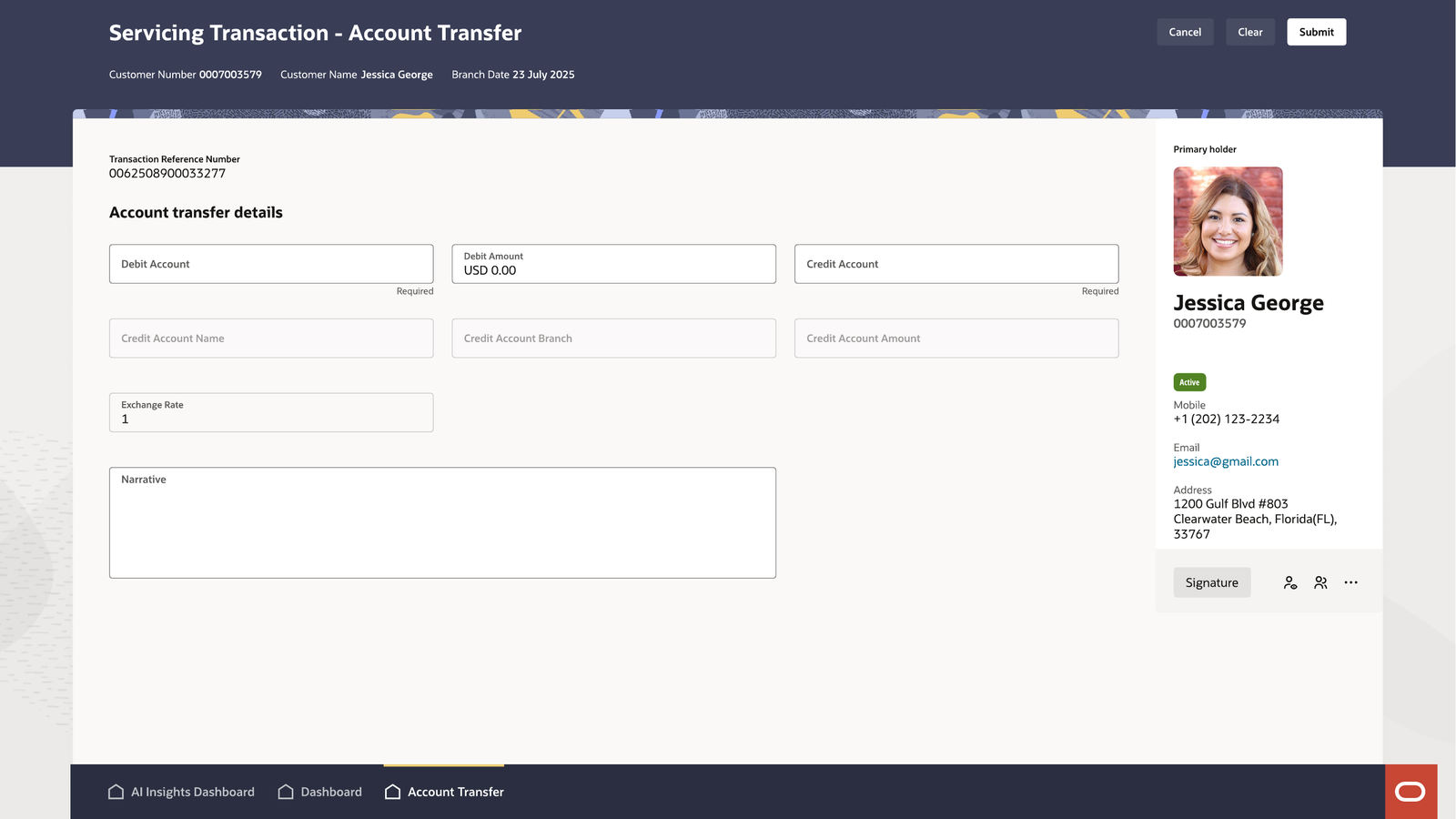
Account transfer action
Contextual action

Account transfer

The banker moves from insight to transaction without searching again.

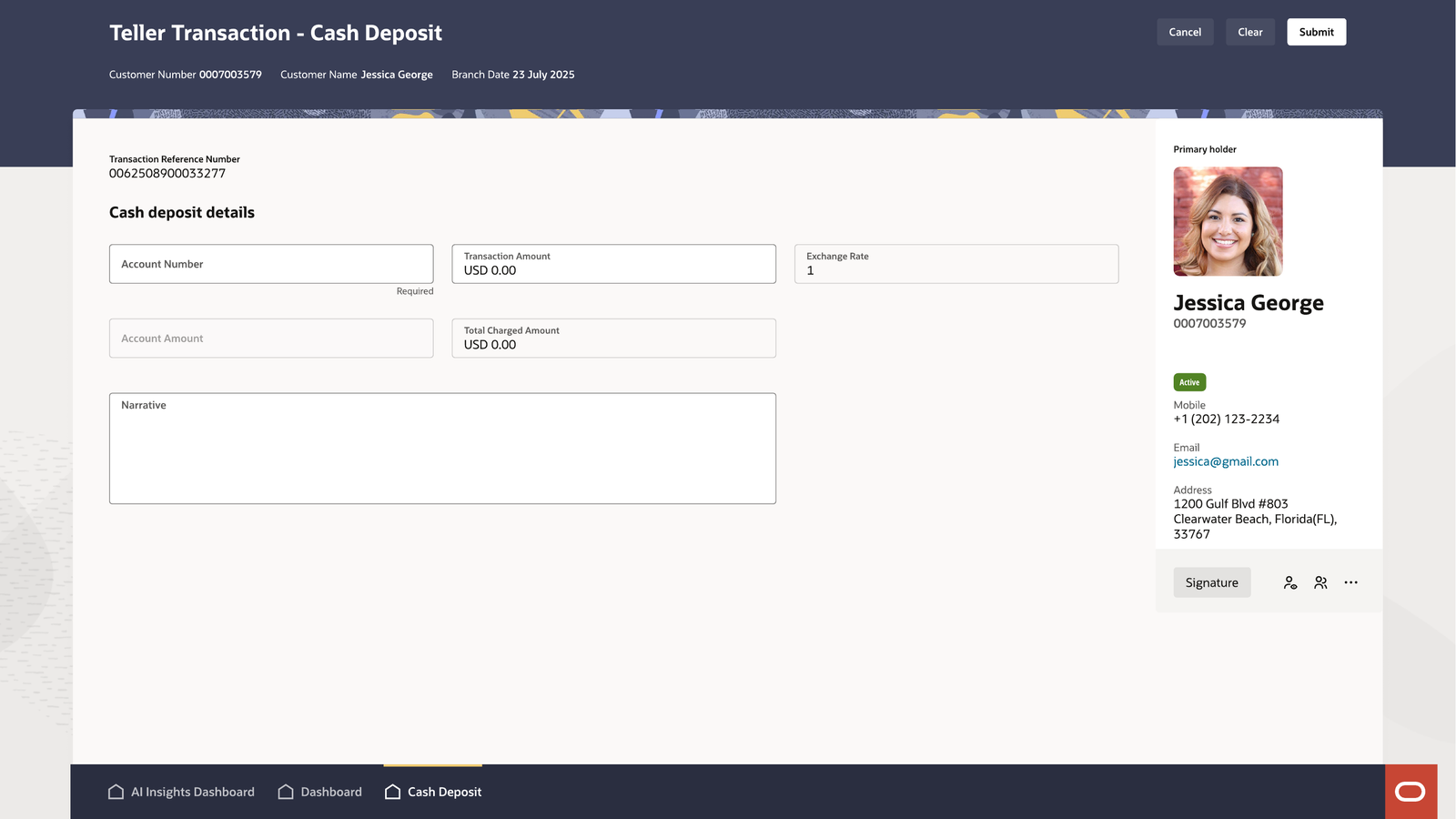
Cash deposit action
Contextual action

Cash deposit

The shared customer context remains visible throughout the transaction.

Responsible use: Sentiment is a conversation-preparation signal, not a fact about the customer or a basis for eligibility, pricing or adverse decisions. The employee must be able to inspect the source, correct the summary and disregard it.
09 · Concept 04 · Explainable Product Recommendations

AI-guided product matching for IRA contributions

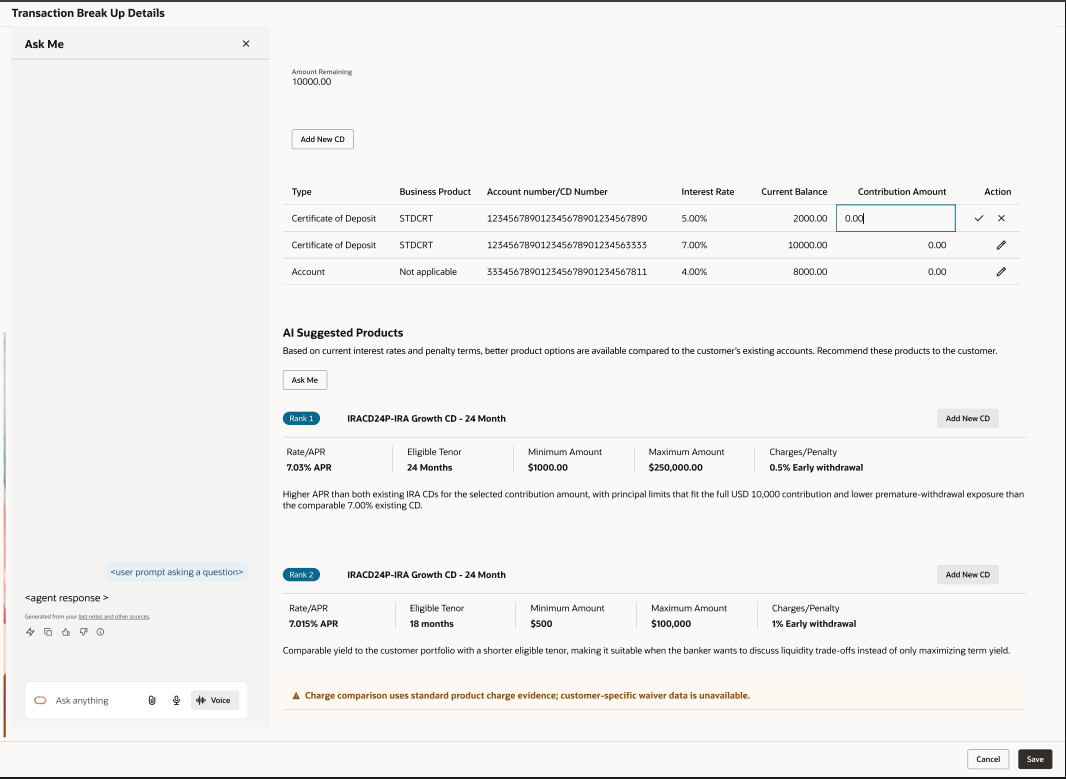
During an IRA contribution, the system compares eligible Accounts and Certificates of Deposit using rate, tenure, minimum and maximum contribution, withdrawal charges and the customer's circumstances. Ask Oracle allows the banker to question the recommendation without leaving the task.

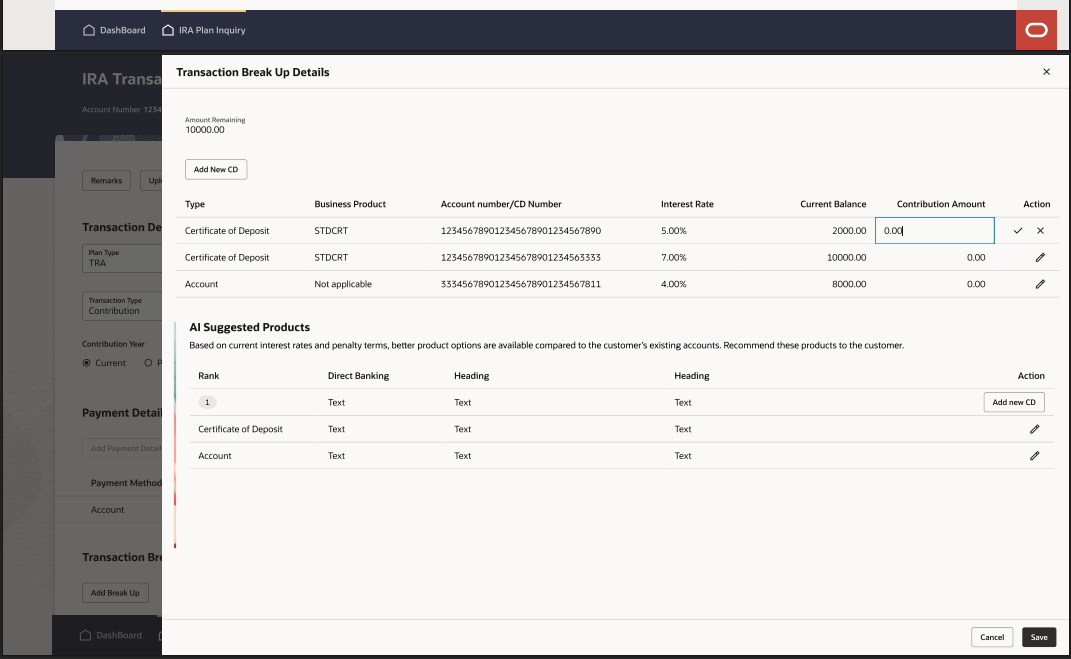
Early AI suggested products table for IRA contribution
Early concept

From generic table to evidence

The first direction surfaced recommendations but did not adequately explain ranking, suitability or missing information.

Ranked IRA product recommendations with Ask Me panel
Refined concept

Ranked, explained and conversational

The updated design exposes comparison criteria, recommendation reasons, source limitations and an Ask Me panel.

Explain the match

Show why the product is relevant to this customer's contribution and portfolio—not only that it is ranked first.

Expose limitations

Make missing waiver, eligibility or customer-specific data visible before the banker discusses the product.

Keep human control

The banker reviews, asks questions, compares options and chooses whether to discuss or dismiss the suggestion.

Product-card requirement: Product name · suitability indicator · why recommended · customer benefit · rate and charges · eligibility · evidence used · missing data · discuss/dismiss action.
10 · Responsible AI Decisions

Trust, control and recovery were treated as product requirements

Decision 01

Progressive disclosure after verification

Customer relationship data remains hidden until the approved identity-verification requirement is met.

Decision 02

Explain recommendations in context

Show the customer evidence, product criteria, limitations and policy checks behind each suggestion.

Decision 03

Design for uncertainty

Low confidence, poor input quality or missing data produces a safe fallback—not a definitive AI conclusion.

Decision 04

Preserve employee judgement

Employees can inspect sources, compare alternatives, correct information, dismiss suggestions and choose the next action.

Decision 05

Separate assistance from decisions

Sentiment and recommendations assist preparation; they do not determine identity, eligibility, pricing or adverse outcomes.

Decision 06

Make the system auditable

Record sources, model or rule version, match outcome, recommendation rationale, employee action and correction feedback.

Governance checklist

ConsentLiveness and anti-spoofingRole-based accessData minimizationEncryption and retentionBias monitoringAudit logsHuman overrideModel-quality monitoring
11 · Validation & Measurement

Measure usefulness, safety and business value together

The strongest success measure is not the number of AI recommendations displayed. The experience must help employees work more efficiently while maintaining customer benefit, suitability, accuracy and trust.

AreaMeasureWhat it reveals
Employee efficiencyPreparation time, screens visited, task completion timeWhether the unified view reduces manual information gathering.
Recommendation qualityAccepted, dismissed and corrected suggestions; suitability exceptionsWhether recommendations are relevant, safe and explainable.
Customer outcomeQualified conversation rate, application completion, satisfactionWhether conversations become more useful—not merely more frequent.
Identity safetyFalse-accept and false-reject rates, fallback completion, spoof attemptsWhether the verification threshold balances access and protection.
AI trustExplanation comprehension, source inspection, override behaviourWhether employees understand when to rely on or challenge the system.
Post-launch valueProduct-view-to-application conversion and incremental qualified salesCommercial impact after suitability and customer-benefit controls are satisfied.
Portfolio wording: “The concept was designed to improve preparation, product relevance and qualified conversations. Production conversion impact requires post-launch measurement.”
12 · Design Leadership & Influence

Connecting AI patterns across Oracle Banking products

The work crossed Branch Servicing, Customer 360, Deposits, Accounts, Teller and IRA. At Principal level, the challenge was to align interaction models across products and ensure specialized AI patterns remained consistent with Redwood standards.

Cross-product alignment

Connected Principal Designers to review shared customer context, recommendation and conversational patterns across Oracle Banking.

Redwood partnership

Worked with the Redwood team when standard components did not cover specialized banking or AI-assistance requirements.

Reusable decisions

Turned one-off screens into repeatable patterns for explanations, confidence, missing data, recovery and contextual actions.

13 · Result

A cohesive vision for AI-assisted branch service

The case study connects secure identification, relationship intelligence, conversation preparation, explainable product matching and servicing actions into one coherent experience. It demonstrates how AI can reduce fragmentation and improve relevance while keeping the employee accountable and the customer protected.

SecureVerify before revealing customer data
RelevantUse relationship context to guide conversations
ExplainableShow evidence, limits and alternatives
ActionableContinue from insight into servicing